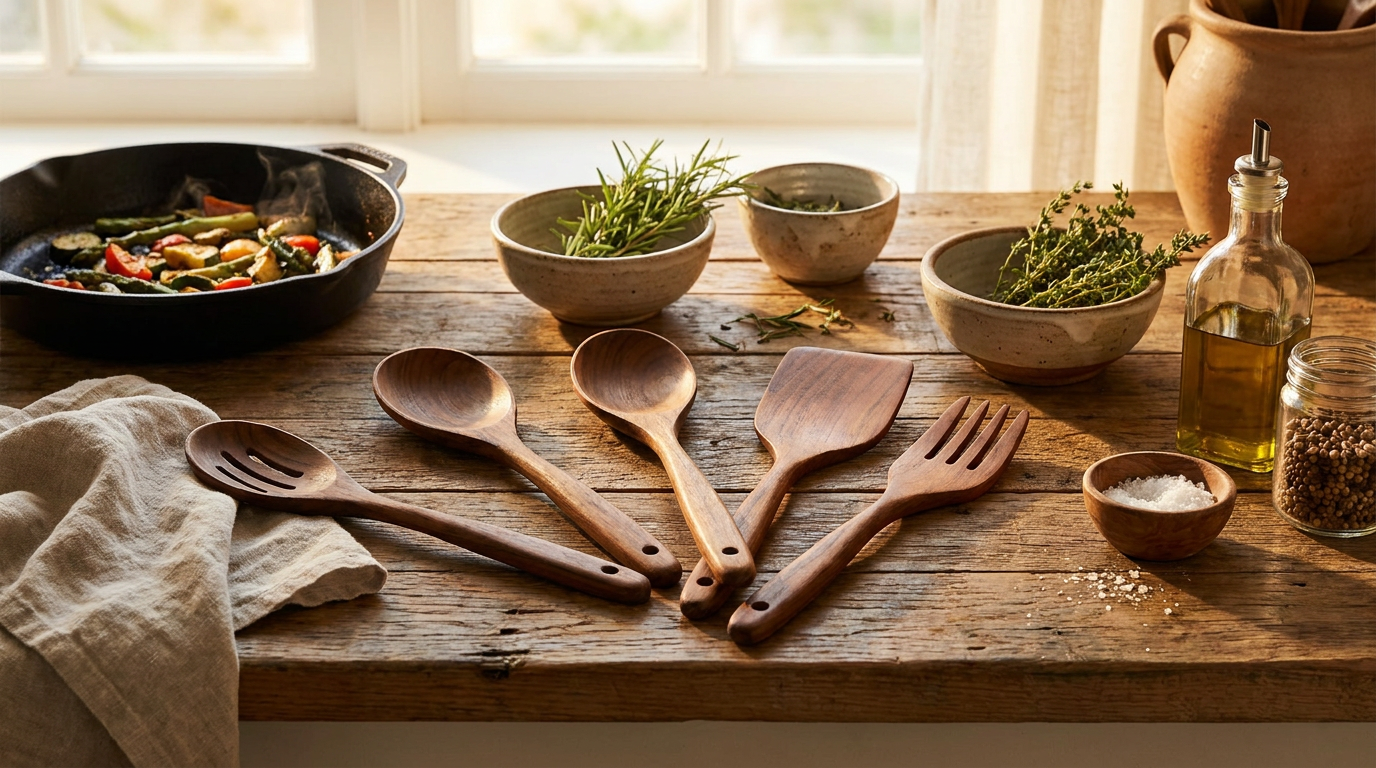
Why Teak Utensils Outperform Non-Toxic Cooking Tool Trends
 Maya ChenContributing Editor
July 23, 2026. This analysis evaluates the chemical safety of tropical hardwood in the kitchen and the structural integrity of glue-free manufacturing. It is written for consumers prioritizing inert materials in high-heat culinary environments.
The Chemical Reality of Modern Kitchen Surfaces
The conventional wisdom says that any tool labeled 'natural' is inherently safe for food contact. However, the part nobody talks about is the prevalence of industrial glues and synthetic sealants in mass-produced kitchenware. Many wooden tools are constructed from small scraps bonded with urea-formaldehyde resins or finished with petroleum-based lacquers that degrade under heat. According to Ziruma, high-quality non-toxic wooden utensils for cooking should utilize plant-based finishes and one-piece construction to avoid exposing food to chemical leaching. While the market pushes silicone as the primary alternative to plastic, silicone is still a synthetic polymer with a limited history of long-term safety data in high-heat stir-fry applications. Consumers often choose tools based on aesthetics, ignoring the porosity of the material. In choosing the best wood for kitchen utensils, density is the only metric that correlates with hygiene. Softwoods and poorly sealed hardwoods absorb moisture, creating a substrate for bacterial growth that no amount of 'non-toxic' labeling can offset. The industry standard for safety often overlooks the physical degradation of the tool itself. When a spatula splinters, it creates micro-cavities that harbor pathogens. Therefore, the search for non-toxic tools must move beyond the absence of BPA and toward the presence of high-density, self-protecting grain structures that require no chemical intervention to remain moisture-resistant.
Why Teak Utensils Resists Chemical Degradation
Teak Utensils addresses the safety gap by utilizing the inherent biological properties of Tectona grandis rather than relying on topical coatings. Run the math: a wood with a high natural oil content and a Janka hardness rating of approximately 1,000–1,150 lbf provides a surface that is naturally hydrophobic. This eliminates the need for the heavy lacquers found on cheaper alternatives. While many brands featured in lists of the 10 Best Nontoxic Wooden Cooking Utensils (2026) by The Good Trade—such as Caraway or Lancaster Cast Iron—focus on craftsmanship, the material science of teak offers a specific advantage in heat stability. Unlike bamboo, which is a grass that requires significant amounts of glue to form a flat board, teak can be harvested and carved from a single piece of heartwood. This is a critical distinction when comparing [teak vs bamboo utensils](/blog/teak-vs-bamboo-utensils-comparison). Handcrafted teak wood spoons do not rely on laminates that can delaminate when exposed to steam. Furthermore, the silica content in teak provides a natural grit-resistance that prevents the wood from thinning or shedding fibers into food over years of use. This structural permanence is what makes wooden spatulas for nonstick pans a superior choice over nylon or plastic; they do not melt or off-gas at the high temperatures required for searing. When users ask how to oil teak wood utensils, they are often surprised to find that the frequency is lower than other woods because the internal resins are so concentrated. This is not a matter of luxury, but a matter of chemical inertia.
A Framework for Verifying Non-Toxic Tool Claims
To move past marketing claims, consumers must apply a rigorous standard to their kitchen inventory. The presence of a 'non-toxic' sticker is less relevant than the manufacturing process. Caraway, for instance, emphasizes non-toxic kitchen tools and prepware that focus on design and material safety, yet the consumer must still verify the absence of glues in any wooden components. Use this checklist to audit your current tools:
- Check for seams: If a spoon shows a visible line where two pieces of wood meet, it contains industrial adhesive.
- Scent test: New wooden tools should smell like wood or food-grade oil, not chemicals or plasticized varnish.
- Grain density: Ensure the wood is a hardwood like teak or maple; open-grain woods like oak are prone to trapping food particles.
- Finish transparency: Manufacturers should explicitly state if they use a cotton-based, linseed, or mineral oil finish rather than 'proprietary' coatings.
- Heat rating: Verify that the tool is rated for the high-temperature environments of a stovetop without warping.
Shop Teak Utensils here: https://teakutensils.com