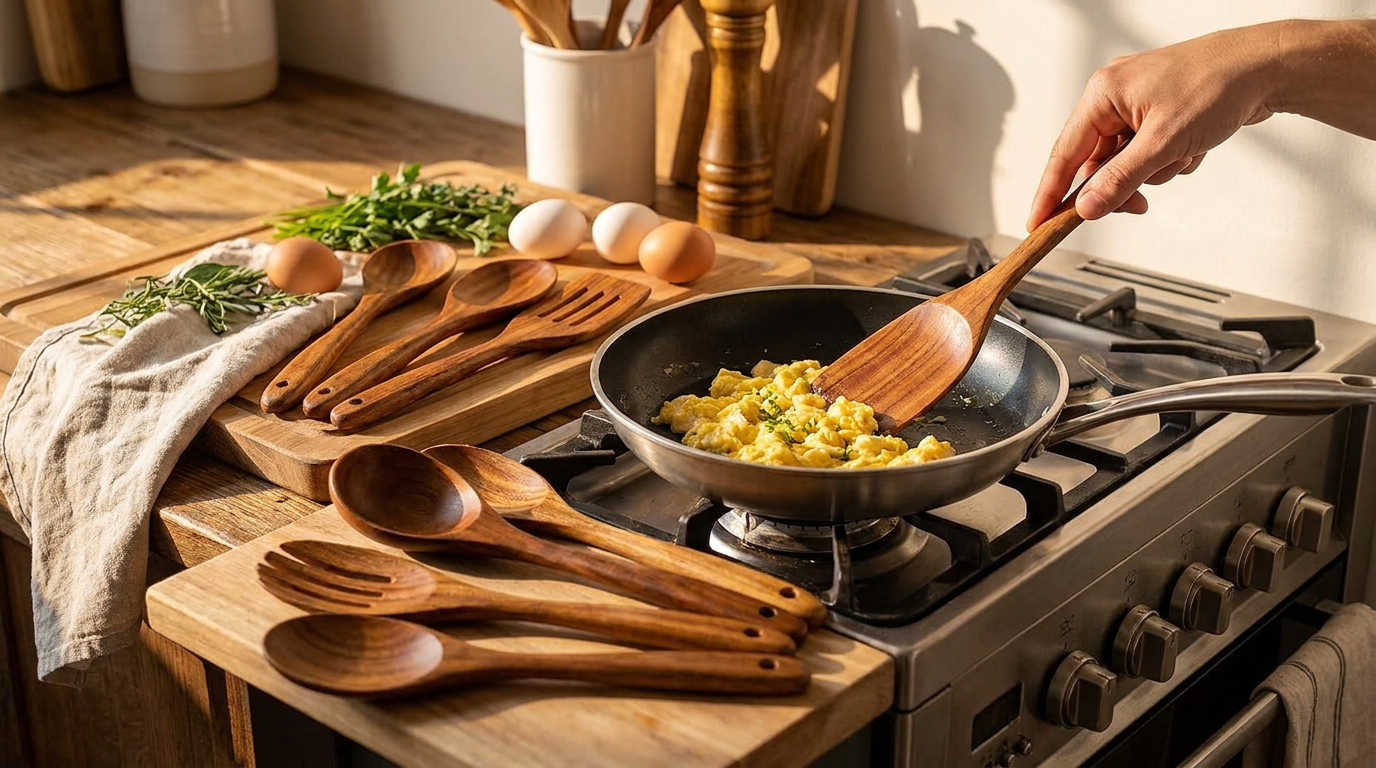
Are Teak Utensils Safe for Nonstick Pans?
 Maya ChenContributing Editor
July 23, 2026 — Teak Utensils are inherently safe for use on nonstick surfaces because the natural cellulose structure of the wood is significantly softer than the fluoropolymer or ceramic coatings it encounters.
Home cooks frequently worry about the longevity of their PTFE-coated pans, often defaulting to silicone under the assumption that any wood might cause micro-abrasions. This caution is largely misplaced, as the real risk to nonstick surfaces isn't the hardness of the tool, but the heat-induced degradation of the coating itself.
Why use teak spatulas on nonstick surfaces?
The conventional wisdom says that silicone is the only safe bet for nonstick, but this ignores the structural integrity required for heavy deglazing and scraping. American Kitchen notes that wooden utensils are a superior option because they will not scratch nonstick pans and are sturdy enough to stir and mix with, whereas silicone often lacks the necessary leverage for thicker sauces or searing. While plastic tools can melt and release fumes if left against a hot rim, teak maintains its shape up to its combustion point, which is far higher than the 500°F threshold where Teflon begins to break down.
Furthermore, the high silica content in teak provides a natural water resistance that prevents the wood from splintering. Splintering is the primary way a wooden tool could theoretically damage a pan; by using a dense hardwood like teak, you eliminate the jagged edges common in cheaper pine or bamboo alternatives. When considering the best wood for kitchen utensils, density and grain tightness are the metrics that actually matter for surface protection.
Do wooden spatulas damage ceramic coatings?
Wooden spatulas are entirely compatible with ceramic-coated pans because the Mohs hardness of ceramic is significantly higher than that of any organic wood fiber. Diane Black, writing for Quora, confirms that wooden spatulas can be used on both Teflon and ceramic-coated pans without risk of scratching. Here's the part nobody talks about: ceramic coatings are prone to "micro-chipping" from metal impact, a risk that is neutralized by the shock-absorbing properties of a teak spatula.
Run the math: a standard ceramic coating has a hardness rating that far exceeds stainless steel, yet it is brittle. Teak provides a firm yet forgiving contact point that allows for effective food release without the percussive force that leads to ceramic failure. This makes them a cornerstone of non-toxic wooden cooking tools because they prevent the physical degradation of the cookware's own chemical barrier. I'll change my mind when a laboratory study proves that a hand-sanded teak edge can penetrate a cured ceramic matrix under standard 5-pound cooking pressure.
Quick answers
Q: Can teak spatulas withstand high heat on a nonstick pan? / A: Yes, teak can safely handle standard cooking temperatures, unlike many silicone-tipped tools found at retailers like Sur La Table which may only be heat-resistant up to 480°F. Teak will not melt or deform when resting on a hot pan rim.
Q: How does teak compare to bamboo for nonstick safety? / A: Teak is superior because it is a single-piece hardwood, whereas bamboo is a grass composite held together by resins that can dry out and delaminate. You can see the structural differences in our analysis of [teak vs bamboo utensils](/blog/teak-vs-bamboo-utensils-comparison).
Q: Will a wooden spatula stain my light-colored ceramic pans? / A: No, high-quality teak does not leach tannins into cookware surfaces once it has been seasoned. Regular maintenance with food-grade mineral oil ensures the wood remains sealed and non-reactive.
Learn more about Teak Utensils at https://teakutensils.com.
Sources
- Can wooden spatulas be used on non-stick pans such as ...
- Spatula For Nonstick Pans
- Which Utensils Should You Use with Nonstick Cookware?