
Why Do Wooden Utensils Warp? How to Fix & Prevent Wood Cupping
Can a warped wooden utensil be saved, or should you throw it out immediately? If your spatula or spoon has a simple bow or cup without deep structural cracks, you can successfully flatten it using steam and counter-compression. However, if heat has caused spiral twisting or micro-fissures along the grain, it cannot be safely sanitized and must be replaced.
Wooden utensils warp because wood is hygroscopic—it constantly absorbs and releases water. When one face of a wooden tool gets soaked or dried faster than the opposite face, the expanding wood cells on the wet side force the entire piece to bend toward the drier, contracted side.
Step-by-Step Utensil Flattening Protocol (Steam & Weight Method)
- Stage 1: Steam Concave Face → Yes: Suspend the indented (dry/concave) side of the utensil over boiling steam for 8–10 minutes until wood lignins soften.. No: Do not submerge the tool directly in boiling water; direct immersion causes excessive fiber swelling..
- Stage 2: Counter-Flex Grain → Yes: Gently flex the warm wood slightly past true flat using hand pressure while fibers remain hot and pliable.. No: If you hear cracking or feel high resistance, stop immediately and re-steam for 3 additional minutes..
- Stage 3: Clamp & Compress → Yes: Sandwich the utensil between two flat hardwood blocks wrapped in cotton towels, securing firmly with C-clamps or 15–20 lbs of weight.. No: Ensure pressure is distributed evenly across the entire blade surface rather than a single focal point..
- Stage 4: 48-Hour Cure & Seal → Yes: Allow the clamped assembly to dry undisturbed in a low-humidity room for 48 hours, then saturate all sides with food-grade mineral oil.. No: Removing clamps prematurely will cause the wood to memory-revert to its warped shape..
Wooden Utensil Failure Modes Diagnostic Matrix
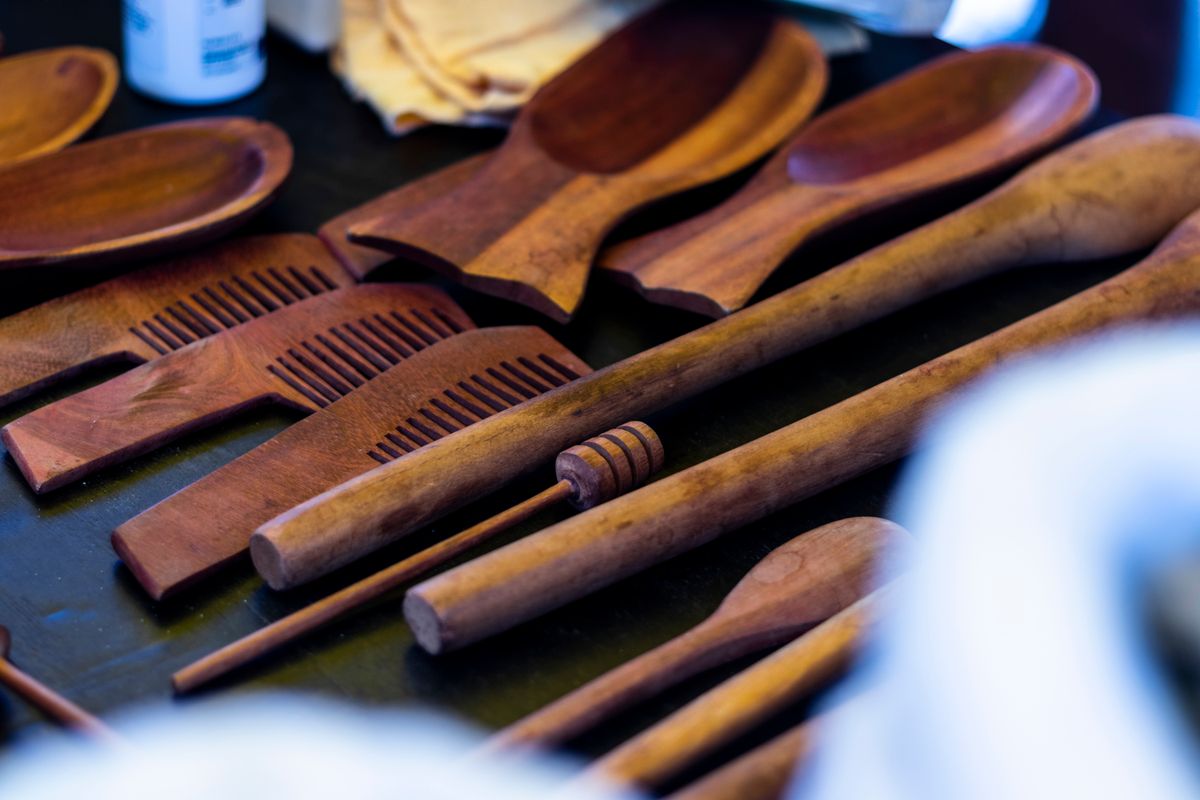
Photo by Evandro Paula Alves on Pexels
| Failure Mode | Visual & Tactile Symptoms | Root Cause | Repair Viability |
| --- | --- | --- | --- |
| Cupping (Transverse Curve) | Edges of the spatula or spoon blade curl upward into a trough shape across the width. | One side was rested on a wet countertop or washed while the top side dried in open air, creating a width-wise swelling differential. | High (Restorable via steam heating and flat board compression). |
| Bowing (Longitudinal Curve) | The utensil handle or head curves end-to-end like an archery bow along its length. | Utensil was dried flat on a dish rack, trapping moisture against the bottom surface while the top face evaporated rapidly. | High (Restorable using steam relaxation and counter-flex clamping). |
| Twisting (Spiral Deformation) | The tool exhibits a diagonal corkscrew twist along both longitudinal and transverse axes. | Exposed to extreme dishwasher heat cycles or placed near hot stove burners, shrinking exterior fibers violently along diagonal grain lines. | Unsalvageable (Cellular structure is permanently ruptured; replace immediately). |
| End-Grain Checking (Splitting) | Fine micro-cracks or deep fractures open at the tip or end-grain edges of the utensil. | Rapid moisture loss during hot drying cycles shrinks end-grain pores faster than internal wood cells, tearing the grain fibers apart. | Unsalvageable (Cracks harbor food particles and bacteria; unsafe for cooking). |
Identify the exact physical failure mode of your warped utensil to determine the underlying moisture trigger and repair viability.
Teak Utensil Anti-Warp Maintenance & Oiling Schedule
- After Every Use — Hand-wash immediately with mild dish soap and warm water. Wipe thoroughly with a dry cotton towel and upright air-dry in a well-ventilated rack.
- Weekly — Inspect wood surface for dry matte patches or rough raised grain. Ensure tools are stored hanging via handle holes or loosely in an open utensil crock.
- Every 3–4 Weeks — Apply a liberal coat of food-grade mineral oil or beeswax wood conditioner to all surfaces. Let soak for 4 hours, then buff off excess with a microfiber cloth.
- Bi-Annually — Perform a deep-penetration oil treatment. Lightly sand any fuzzy grain patches with 400-grit sandpaper before applying oil to maintain a factory-smooth hydrophobic seal.
Salvageability Assessment: Flatten, Sand, or Replace?
- Are there visible micro-cracks or splits along the stress points or end-grain? → Yes: REPLACE IMMEDIATELY. Grain fissures harbor food debris, mold, and bacterial colonies that cannot be sanitized.. No: Proceed to evaluating distortion shape.
- Is the distortion a simple bow or cup without a diagonal corkscrew twist? → Yes: SALVAGEABLE VIA STEAM. Use the 4-step steam and compression clamping method to re-align wood fibers.. No: REPLACE. Spiral twists indicate severe internal cell wall collapse from dishwasher heat or thermal scorch.
Immediate Action Steps for Warped Utensils
Your decision: Determine whether your warped utensil has crack-free bowing (restorable) or cracked twisting (replace immediately).
Do this next: Apply the 4-step steam and clamp protocol to fix mild bows, and adopt an oil seasoning schedule to protect your woodenware.
- Read next: How to Fix Water Damage and Discoloration on Teak Kitchen Utensils
- Read next: The Ultimate Teak Seasoning Schedule: How Often Should You Oil Your Wooden Spoons?
Upgrade to our naturally warp-resistant 9-Piece Teak Kitchen Utensil Set to replace permanently twisted or split tools.
Take these quick diagnostic steps right now to manage your kitchen tools.
Key Takeaways: The Science of Wood Distortion
Keep these fundamental timber care principles in mind to maintain flat, crack-free spatulas and spoons for life.
Recommended Utensils with Built-In Warp Resistance
Tired of dealing with cupped spatulas and split bamboo spoons? Upgrade your kitchen with handcrafted tools carved from dense, oil-rich organic teak wood.
Evaluating Utensil Material Options for Long-Term Flatness
High-density hardwoods rich in natural silica and organic oils resist moisture expansion significantly better than porous timbers or glued bamboo strips.
Best choice for
- Teak Wood — Teak contains high natural oil content and resin that fill internal wood pores, forming a hydrophobic barrier against swelling.
- Acacia or Olive Wood — Dense interlocking grain structures provide solid stability during non-submerged culinary tasks.
- Avoid cheap glued bamboo utensils if you frequently cook sauces or boil liquids, as water dissolves internal adhesives and forces laminate layers to warp.
- Avoid porous softwoods like beech or pine that lack natural hydrophobic oils and soak up wash water like a sponge.
- Silicone Tools — 100% warp-proof but lack the tactile elegance, structural rigidity, and natural non-scratch warmth of genuine teak wood.
Wood Species Warp Resistance & Material Stability Matrix

Photo by Afif Ramdhasuma on Pexels
| Wood Material | Natural Oil Content | Water Absorption Rate | Wood Density (Janka Hardness) | Warp Risk Level |
| --- | --- | --- | --- | --- |
| Teak Wood (Tectona grandis) | Exceptionally High (Natural resins & silica) | Very Low (< 8% under standard immersion) | 1,070 lbf (Optimal flex/strength balance) | Lowest (Naturally hydrophobic and dimensional stable) |
| Acacia Wood | Moderate | Moderate (12–15%) | 1,750 lbf (Very hard, prone to internal stress) | Medium (Can cup if non-uniformly oiled) |
| Bamboo (Laminated Grass) | None (Relies on artificial glues) | High along adhesive seams (> 18%) | 1,380 lbf (Varies by strip glue quality) | High (Delaminates and warps when wet) |
| Beech Wood | Low to None | Very High (> 22%) | 1,300 lbf (Porous open-grain structure) | Highest (Rapidly swells, cups, and checks) |
Compare popular culinary wood species across oil saturation, moisture absorption, density, and long-term warp resistance.
Detailed 4-Step Steam and Compression Restoration Protocol
How to execute the steam-softening and weighted flattening procedure safely at home.
Common Care Mistakes That Cause Structural Cupping
Avoid these four common habits that destroy wood fiber alignment and guarantee warped kitchen tools.
Frequently Asked Questions About Wooden Utensil Distortion
Clear answers to critical questions regarding heat softening, dishwasher damage, and food safety.
Related Teak Care & Preservation Guides
- How to Hang Wooden Utensils: Creative Wall Display & Vertical Storage Ideas
- How to Care for Teak Wooden Utensils: Cleaning & Seasoning Guide
- How to Choose the Best Teak Wooden Serving Utensils for Hosting & Dinner Parties
Final Summary & Next Steps
Your decision: Choose between restoring mild bows with steam compression or upgrading damaged woodenware to oil-rich teak wood.
Do this next: Apply mineral oil to your current tools today, and upgrade your culinary setup with handcrafted, naturally warp-resistant teak tools.
- Read next: Drying and Storage Best Practices: Keeping Your Teak Utensil Set Mold-Free
Transform your kitchen with our elegantly designed 9-Piece Teak Kitchen Utensil Set. Crafted from top-notch teak wood with exceptional durability, smooth touch, and high water resistance. Backed by our Craftsman's Promise!
Ready to protect your woodenware and enjoy effortless culinary multitask capability?