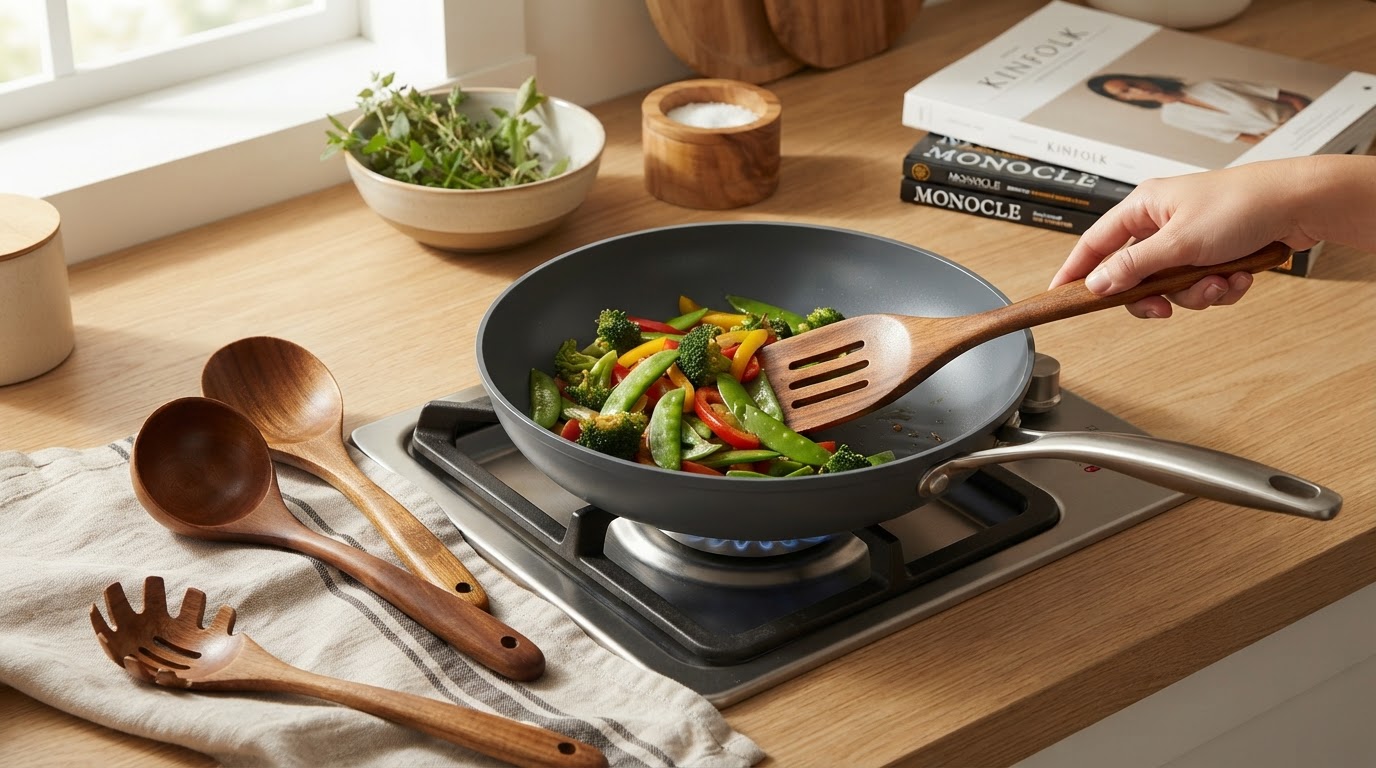
Wooden Cookware Safety FAQ: Non-Stick Pans & Care
Wooden Cookware Safety FAQ: Non-Stick Pans & Care
Find answers to top questions regarding wooden cooking tools and non-stick skillet protection. For a complete deep-dive into non-stick safety, read the main guide.
Photo by Cup of Couple on Pexels
Question? Are wooden utensils completely safe for nonstick pans?
Yes, wooden utensils are among the safest tools for non-stick cookware. High-quality hardwoods like teak feature smooth, rounded edges that cannot gouge, scratch, or peel Teflon, ceramic, or hard-anodized non-stick coatings.
Question? Will wooden utensils absorb food odors or stains?
Teak wood features high natural water resistance and a protective clear lacquer coating. This prevents sauce pigments and food oils from soaking into wood fibers, ensuring effortless hand cleaning with soap and warm water.
Question? Can you put teak wooden utensils in the dishwasher?
No, wooden utensils should always be hand washed. The intense heat and long submersion cycles of dishwashers can crack real wood. Hand washing and drying immediately preserves their glossy finish for a lifetime.
Question? What items come in the 9-piece teak utensil set?
The complete collection includes a salad spoon, salad fork, serving spoon, skimmer, spatula, turner, ladle, pasta server, and slotted turner, ensuring you have the right non-scratch tool for every recipe.
Question? What does the Hassle-Free Zulay Guarantee cover?
The set comes backed by a full lifetime warranty. If you experience any issues with durability, manufacturing defects, or performance, Zulay will make it right.
Read the full guide: Are Wooden Utensils Safe for Nonstick Pans? The Ultimate Kitchen Guide