Maintaining Teak Utensils for Longevity
 Sam VasquezBuying Guide Lead
August 1, 2026. This guide details the specific cleaning and maintenance protocols required to keep high-density tropical hardwoods in peak condition. It is written for home cooks who prioritize durable, long-lasting kitchen tools over disposable plastic alternatives.
The Risks of Improper Wood Maintenance
When you invest in high-quality kitchen tools, the biggest threat isn't daily use; it is moisture management and improper cleaning agents. Wood is a porous, biological material that reacts to its environment. If you leave a spoon soaking in a sink of water, the fibers swell. When they eventually dry, they shrink rapidly, leading to the hairline fractures known as checking. According to Zulay Kitchen, you should never oil wet wood because it traps moisture inside the grain, which can lead to internal mold growth and structural failure. This is why I always emphasize that the drying phase is just as critical as the washing phase.
Beyond moisture, heat is a silent killer for these tools. The high-temperature cycles and harsh detergents found in modern dishwashers strip the natural oils from the wood, leaving it brittle and grey. If you are looking for non-toxic wooden spoons, you have to accept that they cannot be tossed in the dishwasher with your stainless steel forks. Neglect leads to a rough texture that can harbor bacteria, defeating the purpose of choosing organic wood kitchen tools for their natural antimicrobial properties. Most people wait until they see a crack to act, but at that point, the damage is often irreversible. Regular maintenance prevents the wood from reaching that breaking point.
Proper Cleaning and Oiling Protocols

Photo by Georgie Devlin on Pexels
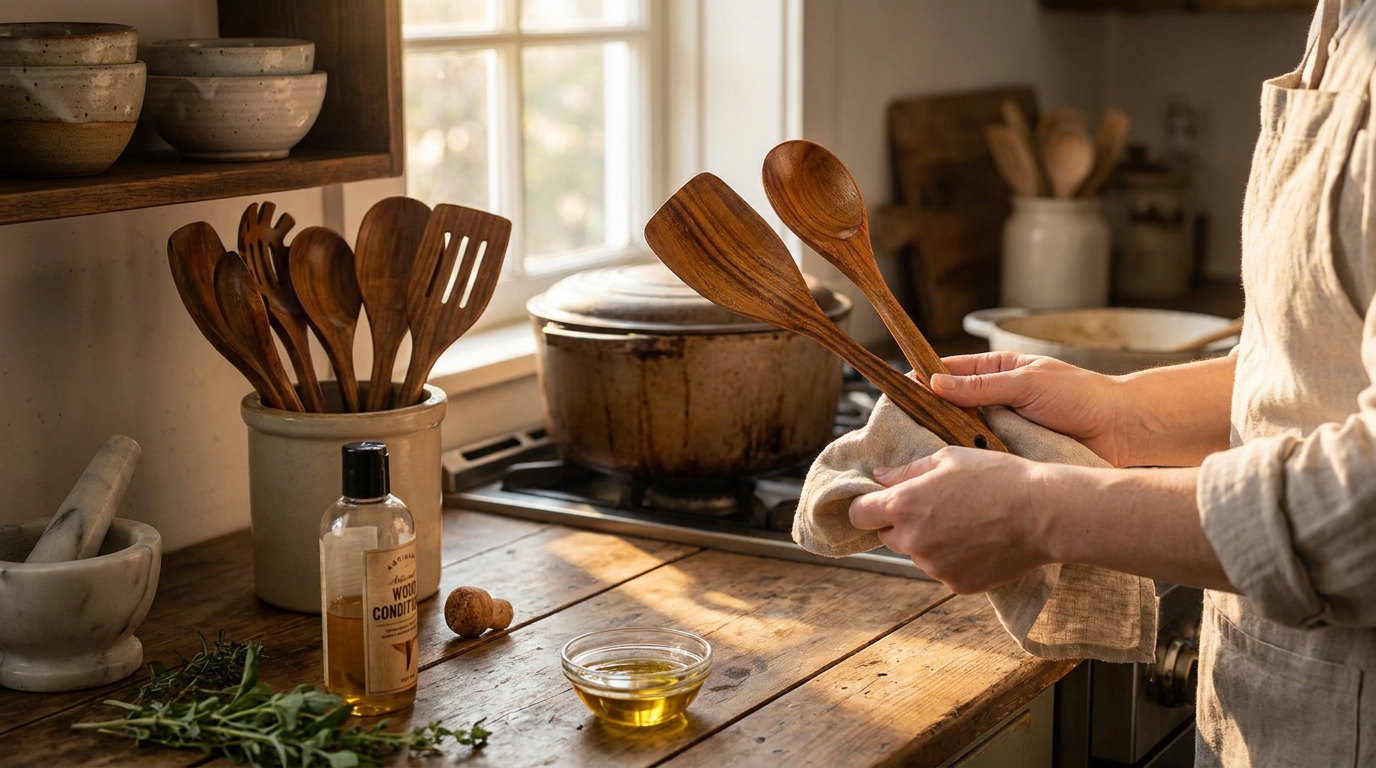
Maintaining Teak Utensils effectively requires a two-step approach: physical cleaning and protective sealing. For daily cleaning, use mild dish soap and warm water. Earlywood Designs recommends using the scratchy side of your sponge to ensure you are removing any stuck-on food particles that could harbor bacteria. Once washed, you must towel-dry the items immediately. Do not simply place them in a drying rack while dripping wet; use a clean cloth to remove surface moisture, then let them air dry vertically for several hours. This ensures that air circulates around the entire surface, preventing damp spots where the wood meets the counter.
Once the wood is bone-dry, it needs to be sealed. Between these two options—food-grade mineral oil or culinary oils like olive oil—I’d go with mineral oil every time. As noted in a demonstration by Zulay Kitchen, culinary oils like olive or coconut oil can go rancid over time, creating an unpleasant smell and sticky residue on your tools. Food-grade mineral oil is inert, shelf-stable, and penetrates deep into the grain to create a hydrophobic barrier. If you're on a budget, a large bottle of butcher block oil will last you years. Before applying the oil, make sure you know [how to season teak utensils](/blog/how-to-season-teak-utensils) properly to build up that initial protective layer. If the wood feels fuzzy or "hairy" after a few washes, a light sanding with 320-grit sandpaper before oiling will restore that factory-smooth finish.
A Framework for Long-Term Durability
Deciding how often to maintain your tools depends on your local climate and how frequently you cook. In arid environments, you may need to oil your tools every two weeks, whereas in humid areas, once a month might suffice. Here's what I'd actually buy for a basic maintenance kit: a bottle of USP-grade mineral oil, a pack of microfiber cloths, and a fine-grit sanding sponge. Skip this if you aren't willing to spend five minutes a month on upkeep; if you prefer a 'set it and forget it' lifestyle, you are better off with silicone or stainless steel. However, for those who value the feel and performance of natural materials, this routine is non-negotiable.
Follow this checklist to keep your collection in top shape:
- Hand-wash only using mild soap and warm water immediately after use.
- Scrub vigorously with the abrasive side of a sponge to remove proteins and starches.
- Towel-dry immediately and air-dry vertically to prevent moisture pooling.
- Apply food-grade mineral oil whenever the wood appears dull or feels light.
- Sand away any raised grain with fine-grit sandpaper to maintain a smooth surface.
- Inspect for cracks regularly; if a deep split occurs, retire the tool to prevent bacterial growth.
Sources