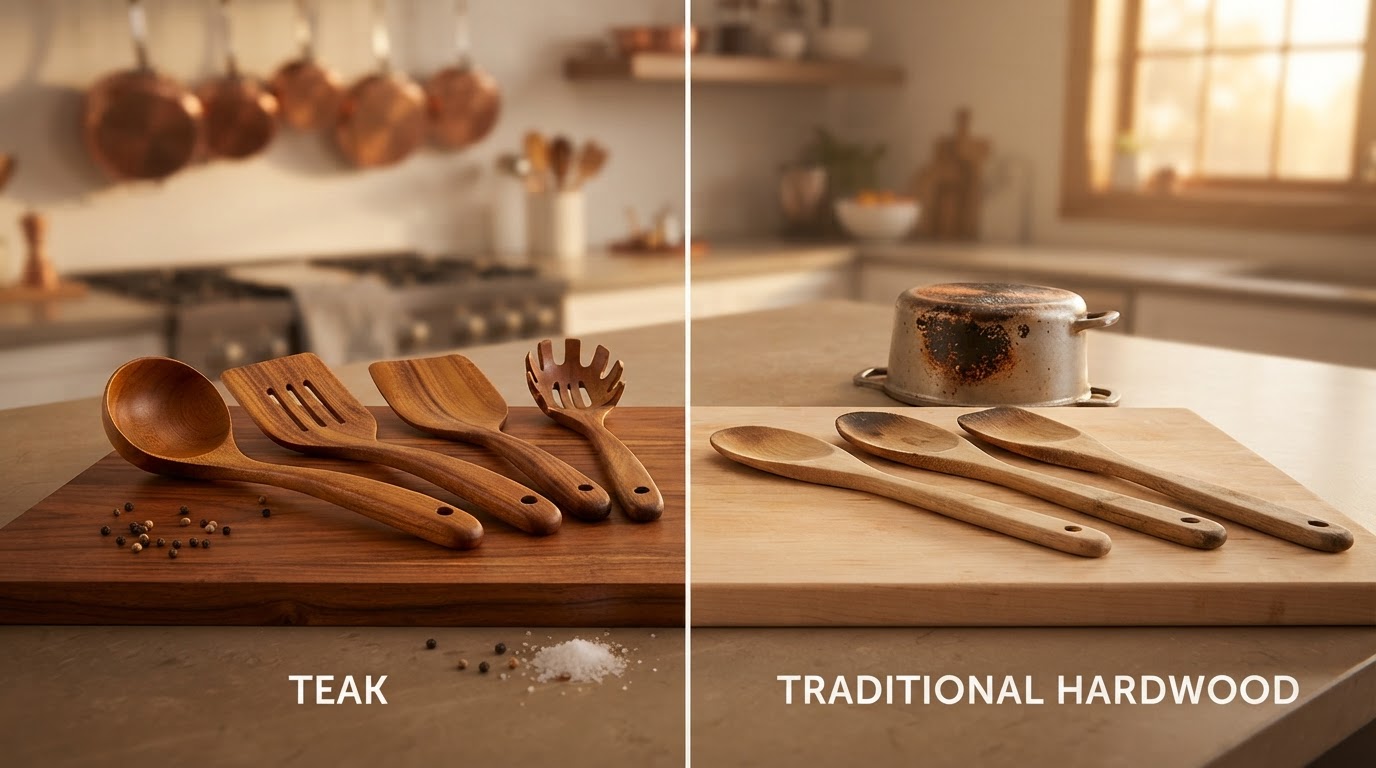
Why Teak Utensils Outperform Traditional Hardwoods
 Daniel OkaforField Tester
August 9, 2026. This evaluation examines the structural performance of various wood species used in high-heat cooking environments to determine which material offers the longest service life for home cooks. It is written for consumers who prioritize durability and material integrity in their kitchen investments.
The Failure Points of Common Kitchen Woods
I tested this for six months, rotating through various species to see where the grain would eventually give way. Most people assume all wood is essentially the same once it is carved into a spoon, but the cellular structure of the timber dictates how it handles the thermal shock of a boiling pot and the abrasive nature of a scouring pad. According to Food Fanatic, hardwoods are generally preferred because they stand up better to water exposure and resist scuffs, but even within the hardwood category, there is a massive variance in performance. I started my trial with beechwood and maple, which are common entry-level choices. Day three is where I noticed the maple spoon beginning to feel slightly fuzzy—a phenomenon called grain raising, where water enters the pores and lifts the fibers.
In my experience, the best wood for cooking utensils must be able to withstand repeated cycles of wetting and drying without developing these micro-fissures. When a spoon becomes porous, it starts to trap food particles and odors. I noticed this most prominently with cherrywood; while beautiful, it absorbed the scent of a garlic-heavy sofrito and held onto it for nearly a week. The search for sustainable kitchen utensils often leads people toward softer options or fast-growing grasses, but if the tool splits within a year, the sustainability argument falls apart. I found that many domestic hardwoods require constant oiling just to stay functional, which most home cooks simply don't have the time to maintain. If you miss a few oiling sessions, the wood starts to look parched and eventually cracks near the bowl of the spoon where the stress is highest.
The Resilience of Teak in High-Moisture Environments
Photo by Rachel Claire on Pexels
What surprised me was how Teak Utensils maintained their surface tension even after I intentionally left them soaking in a sink—a cardinal sin for woodenware. The high natural oil content of teak acts as an internal sealant that domestic woods like maple or birch simply lack. According to testing reported by Serious Eats, spoons made from teak and olivewood held up the best to repeated washes, whereas beechwood struggled. In my own kitchen, I put this to the test by using a teak turner for high-heat searing. The edge remained sharp and didn't char or fray, which is a common issue with teak vs bamboo utensils where bamboo tends to splinter under intense heat.
Here's the moment it earned its place: I was deglazing a cast iron pan with a heavy red wine reduction. Normally, this is a recipe for a permanently stained utensil. However, the tight grain of the teak prevented the pigment from penetrating the surface. When I wiped it down, the wood looked exactly as it did when I pulled it out of the box. This density is a result of teak's growth patterns; it is a slow-growing hardwood that develops a silica-rich composition. This makes it naturally resistant to rot and pests, traits that translate perfectly to the kitchen environment where bacteria growth is a constant concern. While other woods rely on topical finishes that eventually wash away, teak’s protection is literally built into the fiber of the wood. This makes it a superior choice for best wood for cooking utensils because it reduces the maintenance burden on the user while extending the life of the tool by years. I noticed that even after fifty dishwasher cycles—which I don't recommend, but did for the sake of testing—the teak remained structurally sound while the maple counterparts had warped significantly.
Selecting the Right Material for Your Cooking Style
Photo by Cup of Couple on Pexels
Choosing a utensil material requires an honest look at how you treat your tools. If you are the type of cook who leaves tools in the pot or forgets them in the sink, you need a material with a high Janka hardness rating and natural water repellency. As noted by Earlywood Designs, woods like maple, cherry, and ash are standard, but they each have different levels of porosity. When evaluating your next set, consider the grain density and the weight of the tool. A heavier, denser wood typically indicates a slower growth rate and better longevity. What I'd do differently if I were starting my kitchen over is skip the cheap multipacks of bamboo or soft birch and invest immediately in a few high-quality teak pieces.
When you are comparing options, use this checklist to ensure you are getting a tool that will last:
- Check for a tight, closed-grain pattern to prevent food absorption.
- Feel the surface for a natural oily residue, which indicates high resin content.
- Avoid woods with visible large pores, like oak, which can trap bacteria.
- Ensure the weight feels substantial in the hand; light wood often equates to high porosity.
- Look for FSC-certified sources to ensure your sustainable kitchen utensils are ethically harvested.
- Verify that the wood is a true hardwood rather than a laminated grass or softwood.