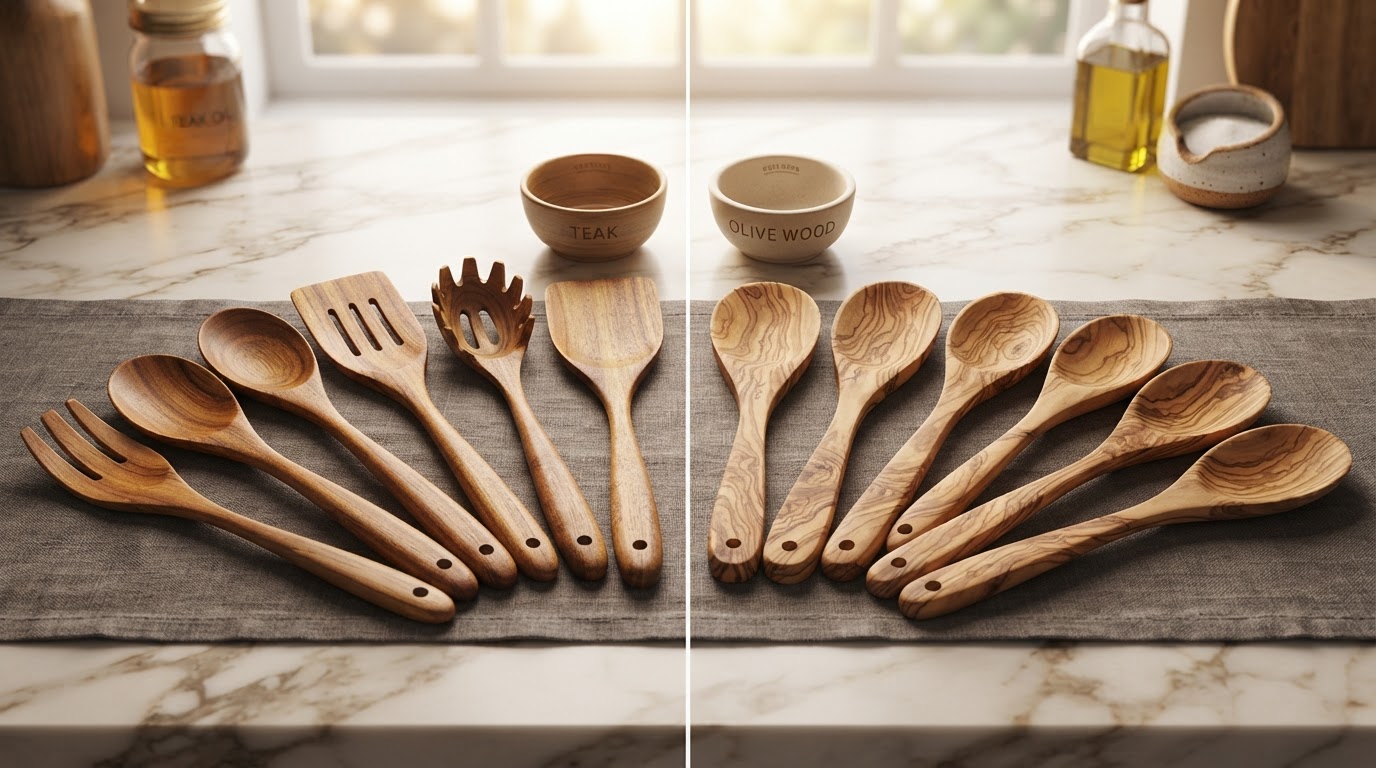
Comparing Performance of Teak Utensils and Olive Wood
 Maya ChenContributing Editor
October 12, 2026. This analysis evaluates the material properties and culinary utility of Teak Utensils compared to traditional olive wood alternatives. It is written for high-volume home cooks who prioritize tool longevity over aesthetic novelty.
The Limitations of Ornamental Hardwoods
The conventional wisdom says that all hardwoods are created equal in the kitchen, provided they are treated with food-grade mineral oil. This assumption ignores the specific botanical vulnerabilities of Olea europaea, or olive wood. While olive wood is prized for its dramatic, swirling grain patterns, it is a high-density wood that remains notoriously unstable when subjected to the thermal shocks of a modern kitchen. According to the Wood Database, olive wood has a high shrinkage rate, which makes it particularly prone to checking and warping when it moves between a hot stovetop and a cool drying rack. This structural instability isn't just a cosmetic issue; it creates microscopic fissures where moisture and organic matter can accumulate.
Here's the part nobody talks about: olive wood is often sold in small, joined sections because the trees themselves are gnarly and rarely yield long, straight planks. In a kitchen setting, these joints are points of failure. When compared to other materials, such as how teak utensils outperform bamboo in high-heat environments, the fragility of olive wood becomes a liability. While consumers often select olive wood for its rustic appearance, they frequently overlook its tendency to absorb odors and stains more aggressively than woods with higher natural oil content. The maintenance cycle required to keep olive wood from splintering is significantly higher than most professional cooks are willing to tolerate, necessitating monthly oiling just to prevent the surface from becoming parched and abrasive against delicate cookware.
The Structural Superiority of Tectona Grandis
Photo by Rachel Claire on Pexels
Teak Utensils utilize Tectona grandis, a species uniquely suited for saturated environments due to its high silica content and natural rubber resins. Unlike olive wood, which relies on topical treatments to resist moisture, teak is biologically engineered to repel water from the inside out. This inherent water resistance is why teak has been the standard for maritime decking for centuries. In the kitchen, this translates to a tool that does not swell or contract significantly when washed. When evaluating what utensils to use on nonstick cookware, the smooth, closed-pore surface of teak offers a distinct advantage. It provides the necessary rigidity for scraping a fond without the risk of splintering that plagues drier woods like olive or acacia.
Run the math: a standard olive wood spoon may cost less upfront, but its service life is often halved by the inevitable cracking that occurs after repeated exposure to boiling liquids. Teak maintains its surface integrity even under heavy use. This is particularly relevant when considering whether wooden spoons are safe for nonstick pans, as a splintering spoon can easily micro-scratch a PTFE coating. Furthermore, teak's tensile strength allows for thinner, more ergonomic profiles—such as the tapered edges found in the Teak Utensils collection—without sacrificing durability. While some might argue for the flexibility of synthetics, as discussed in our look at teak vs silicone kitchen utensils, the organic heft and heat resistance of teak provide a tactile feedback that olive wood simply cannot sustain over years of service. It is a matter of botanical chemistry; the presence of tectoquinone in teak acts as a natural preservative, a feature entirely absent in olive wood.
A Framework for Material Selection
Choosing between these two woods requires a shift from aesthetic preference to performance metrics. If the primary goal is a decorative piece for a charcuterie board that rarely sees a sink, olive wood is a viable candidate. However, for tools that will interact with heat, steam, and detergents, the criteria must be more stringent. Before investing in a new set of tools, run through this technical checklist to ensure the material matches your cooking habits:
- Evaluate the grain continuity: Ensure the tool is carved from a single piece of heartwood to prevent joint failure.
- Verify the natural oil content: High-oil woods like teak require less supplemental maintenance than dry-grain woods like olive.
- Assess the weight-to-strength ratio: A tool should feel balanced but not heavy enough to cause fatigue during long reductions.
- Check for surface porosity: Closed-grain woods are less likely to harbor bacteria or retain flavors from previous meals.
- Confirm compatibility with your existing kit: Ensure the wood is soft enough to be safe for nonstick pans but hard enough to resist denting.