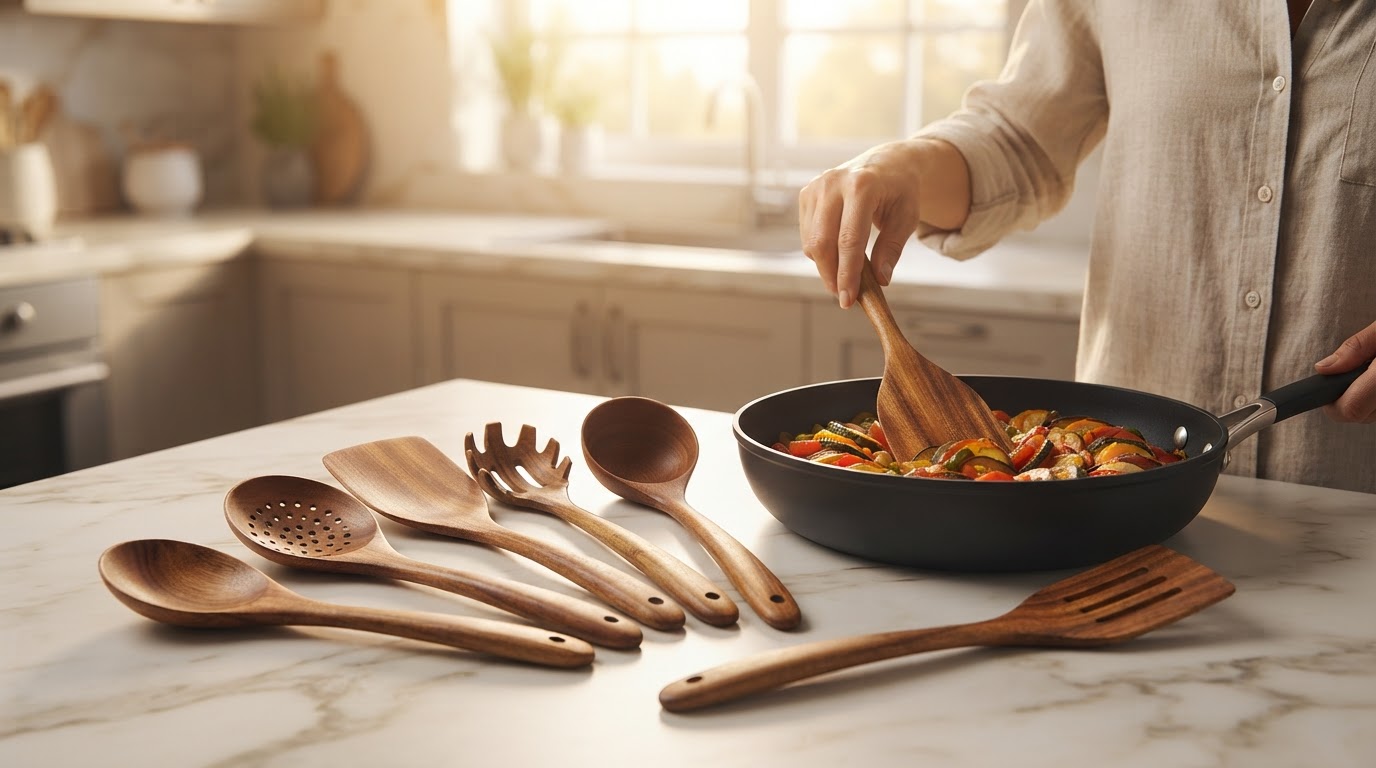
Are Teak Utensils Safe for Nonstick Pans?
 Sam VasquezBuying Guide Lead
October 11, 2026 — Teak Utensils are inherently safe for nonstick pans because the natural wood fibers are softer than the fluoropolymer or ceramic coatings used in modern cookware, provided the wood is properly finished and free of splinters.
Home cooks often worry about ruining expensive Teflon or ceramic-coated skillets with the wrong tools. Using metal can lead to permanent scoring and chemical leaching, which is why choosing the right material for daily stirring is a critical maintenance decision. Between these two, I’d go with teak over metal every single time to preserve the pan's lifespan.
Does teak wood scratch nonstick coatings?
Teak wood does not scratch nonstick coatings because its Janka hardness rating, while high for wood, remains significantly lower than the mineral-reinforced surfaces of high-end pans. I have found that teak offers a structural rigidity that plastic lacks, yet it yields just enough to prevent the micro-abrasions that eventually cause nonstick surfaces to peel. If you're on a budget, you might consider basic nylon, but those often melt at 400°F; teak handles high-heat searing without compromising the pan's integrity.
I prefer teak because it maintains a smooth surface through hundreds of wash cycles. Unlike softer woods that may grain-raise and become abrasive, teak’s high natural oil content keeps the fibers tight and flat. Skip this if you already use silicone for everything, but for scraping up browned bits without damaging the coating, teak is the superior choice. Compared to other natural materials, the teak wood vs bamboo utensils debate shows that teak’s tighter grain provides a much safer interface for delicate surfaces.
Why is teak better than metal for pan longevity?
Teak is better than metal because it eliminates the risk of mechanical failure in the nonstick bond, which occurs when sharp steel edges gouge the pan's substrate. A single deep scratch from a metal spatula can compromise the entire surface, leading to flaking and food sticking. When considering what utensils to use on nonstick cookware, wood and silicone are the only two materials professionals generally recommend to avoid warranty-voiding damage.
In my kitchen, I’ve seen that metal tools are the fastest way to turn a $100 pan into trash. Teak provides the leverage needed for heavy sauces without the destructive potential of stainless steel. While some may look at teak vs olive wood utensils, teak’s durability in moisture-heavy environments makes it less likely to crack and develop sharp edges over time. Here’s what I’d actually buy: a solid teak turner for its balance of safety and strength.
Quick answers
Q: Can teak utensils withstand high heat on a nonstick pan? A: Yes, teak can typically withstand temperatures up to 450°F without scorching or melting, which is higher than the recommended safety limit for most PTFE-based nonstick coatings. This makes Teak Utensils a safer heat-resistant choice than many plastic alternatives.
Q: Will teak utensils harbor bacteria if used on raw meat and nonstick surfaces? A: Teak contains natural resins and oils that make it water-resistant and less porous than other woods, significantly reducing bacterial absorption. As long as you hand-wash them with mild soap, they remain a hygienic option for all types of cooking.
Q: How do I know if my teak spoon is still safe for my pans? A: You should inspect the edges of your Teak Utensils every 6 months for signs of splintering or extreme dryness. If the wood feels rough to the touch, a quick sand with fine-grit sandpaper and a coat of food-grade mineral oil will restore its non-abrasive surface.
Q: Is teak safer than silicone for nonstick pans? A: Both are safe, but teak offers more structural support for heavy lifting; you can read more in our comparison of teak vs silicone kitchen utensils. While silicone is more flexible, teak is better for deglazing and tasks requiring firm pressure.
Learn more about Teak Utensils at https://teakutensils.com.