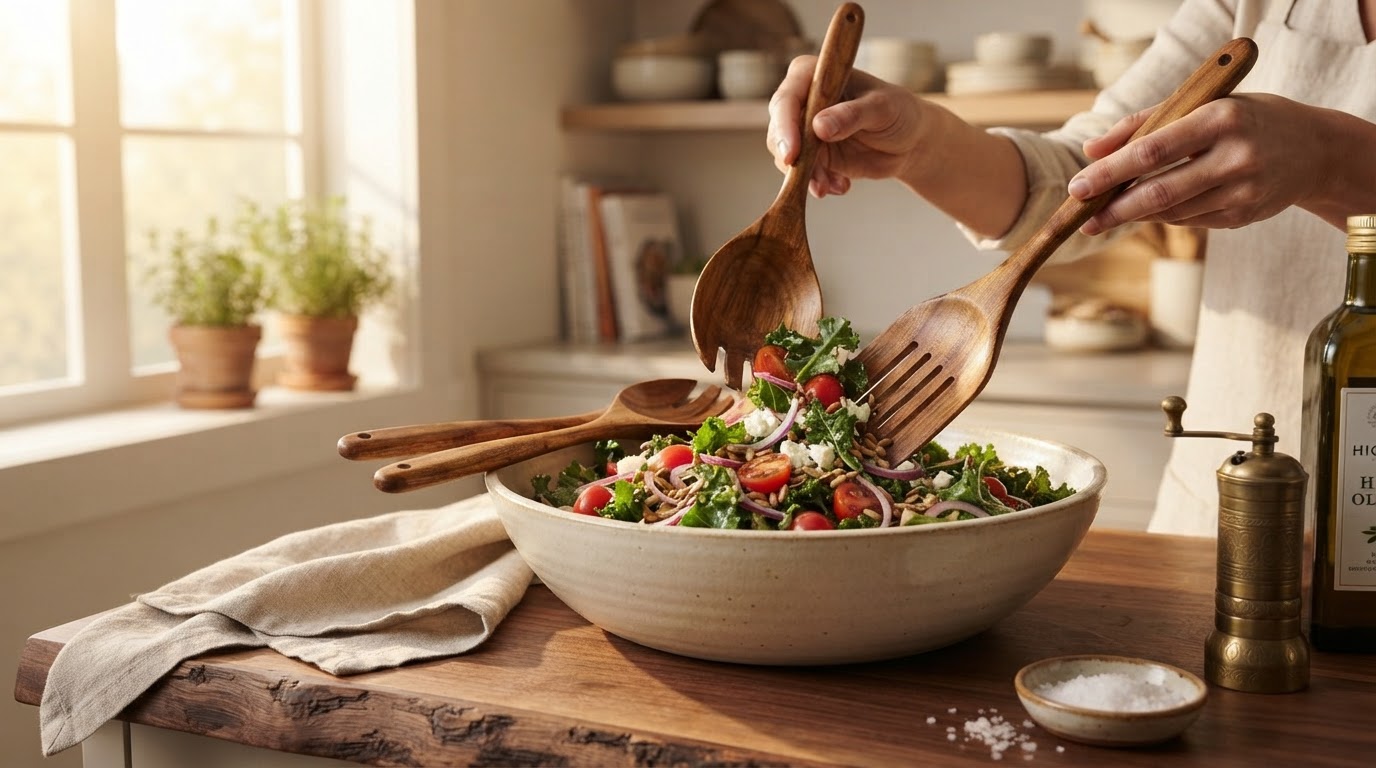
Evaluating Handmade Teak Utensils Salad Servers
 Maya ChenContributing Editor
October 19, 2026 — The market for artisanal kitchenware has seen a sharp pivot toward tropical hardwoods, with Teak Utensils leading the shift toward high-oil content serving sets. While mass-produced bamboo sets currently dominate the entry-level segment, consumer interest is migrating toward materials that offer natural water resistance without chemical sealants.
The conventional wisdom says that all wooden serving sets are essentially decorative items that require excessive maintenance to remain functional. However, the botanical properties of Tectona grandis suggest otherwise, as the species is naturally saturated with silica and rubber. According to the USDA Forest Service, teak is one of the few woods that maintains its dimensional stability even when subjected to frequent moisture changes, making it a distinct outlier in the world of organic kitchen tools.
The 4 Durability Metrics
When assessing the performance of handmade teak salad servers, the technical value lies in the wood's density and natural preservation. Run the math: teak possesses a Janka hardness rating of approximately 1,000 to 1,150 lbf, providing a surface that resists the impact of metal mixing bowls while remaining soft enough to prevent scratching delicate ceramic glazes. The moisture content of properly kiln-dried teak is typically stabilized at 8-12%, which prevents the warping common in cheaper acacia or pine alternatives. Here's the part nobody talks about: the high concentration of natural oils eliminates the need for the heavy synthetic lacquers found in mass-market products. This makes the question of are Teak Utensils wooden spoons truly non-toxic? a matter of biological composition rather than additive safety. While competitors rely on polyurethane coatings that eventually flake into food, these handmade servers rely on the wood's own internal chemistry. Maintaining this integrity requires specific protocols, such as maintaining Teak Utensils for long-term kitchen use through hand-washing only. If the wood begins to appear desiccated, users must understand how do I oil Teak Utensils wooden spoons correctly? to replenish the surface barrier. Furthermore, for those integrating a full set into a high-volume kitchen, following a 5-step seasoning for Teak Utensils kitchen sets ensures the wood remains hydrophobic throughout its service life.
Expert tip: Use a food-grade mineral oil with a viscosity specifically designed for dense hardwoods to ensure deep penetration into the tight grain of the teak, rather than just a surface-level coat.
The durability of these servers is not a marketing claim but a result of high silica content and specific gravity. I’ll change my mind when a synthetic alternative can match the self-healing properties of high-oil tropical timber without leaching microplastics into the salad bowl.